Little Alchemy Classic · a shared discovery plan
Little Alchemy Cheats in Order: Plan Several Discoveries Together
Choose your targets together, then make their shared ingredients before the final discoveries. Add what you already own to skip it. This planner gives a valid dependency order, not a shortest route or a fixed order for finishing the whole game.
Jump to the worked plan ↓What do you want to discover?
Choose up to eight regular Classic elements. Start with life and human, or change the goals.
Separate exact names with commas. List only elements you really have. This does not read or update your game save.
Your dependency order
Loading the Classic recipe facts…
The CSV is a reading checklist, not a game-save file. Reloading restores the example; this page does not save your selections.
Human in Little Alchemy Classic
You make a human in Little Alchemy Classic by combining earth with life.
earth + life → human
This is the original game's pair from the official Classic Human hint. Find its ingredients in the Classic hints finder. Playing the sequel? Use the separate Little Alchemy 2 Human guide.
Plan the destination set before copying separate routes
A route to life and a route to human overlap. If you copy each route into its own checklist, you repeat the earlier outputs even though your destination set needs them only once. This planner starts with the targets you choose, builds a prerequisite proof for each one, then joins the proofs into a single ordered list. An output appears after its required ingredients and is not printed again for the next target.
The order is local to your choices. It is not a universal completion sequence. Add a different goal and the list can grow; declare a useful ingredient already owned and part of the list can disappear. The planner trusts that declaration. It does not inspect your actual library, infer your discoveries from a counter or silently tick everything that could lead to an ingredient you entered.
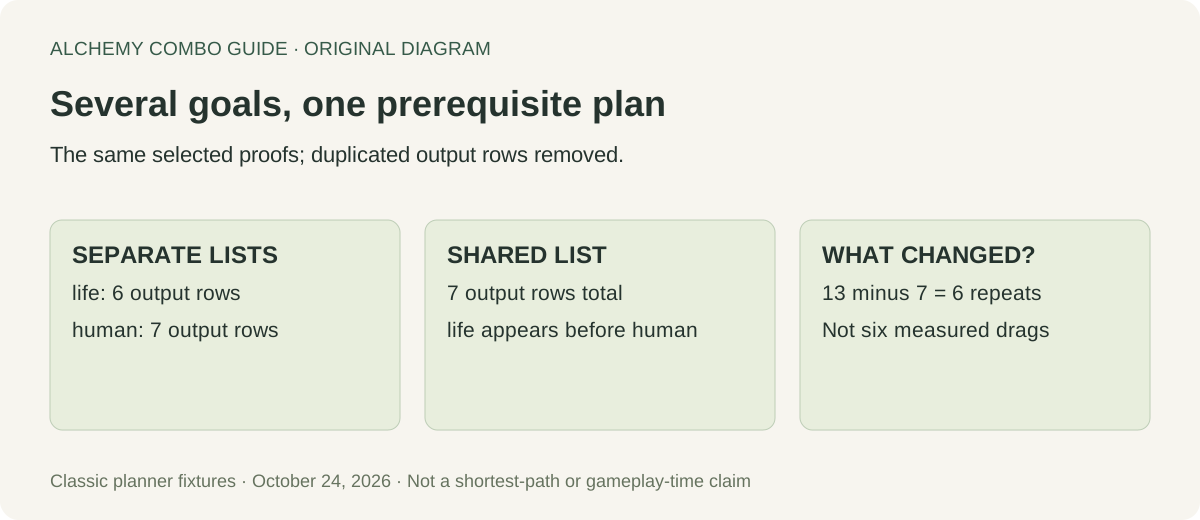
Our dated comparison: separate lists versus one shared list
We ran these planner fixtures on October 24, 2026, using the same regular Classic data and the same route-selection rule in each case. The starting checklist contained air, earth, fire and water. Planning life alone returned six output rows; planning human alone returned seven. Concatenating those separate lists gives thirteen rows. Joining the same target proofs gives seven rows, so thirteen minus seven equals six repeated output rows removed.
| Declared checklist | Separate lists | Shared list | Repeated rows removed |
|---|---|---|---|
| Starting elements; targets life and human | 13 | 7 | 13 − 7 = 6 |
| Starting elements plus life; same targets | 1 | 1 | 1 − 1 = 0 |
| Starting elements plus energy and swamp; same targets | 3 | 2 | 3 − 2 = 1 |
| Starting elements; targets human then life | 13 | 7 | 13 − 7 = 6 |
These are measured outputs of our software, not timed play sessions. They do not show that a player saves six drags, finishes faster or has found a shortest solution. Someone following separate guides may already recognise the overlap. The comparison establishes a narrower result: this interface removes duplicated output rows from these selected proofs. Alternative recipes may produce another valid order.
To repeat the comparison, reset the example and inspect the separate-row and shared-row counters. Add life to the owned-elements box and rebuild. Only human should remain. Reset again, then add energy and swamp instead; life must appear before human. Change one input at a time so you can tell which declaration changed the plan. Download each CSV if you want to compare the lists outside this browser.
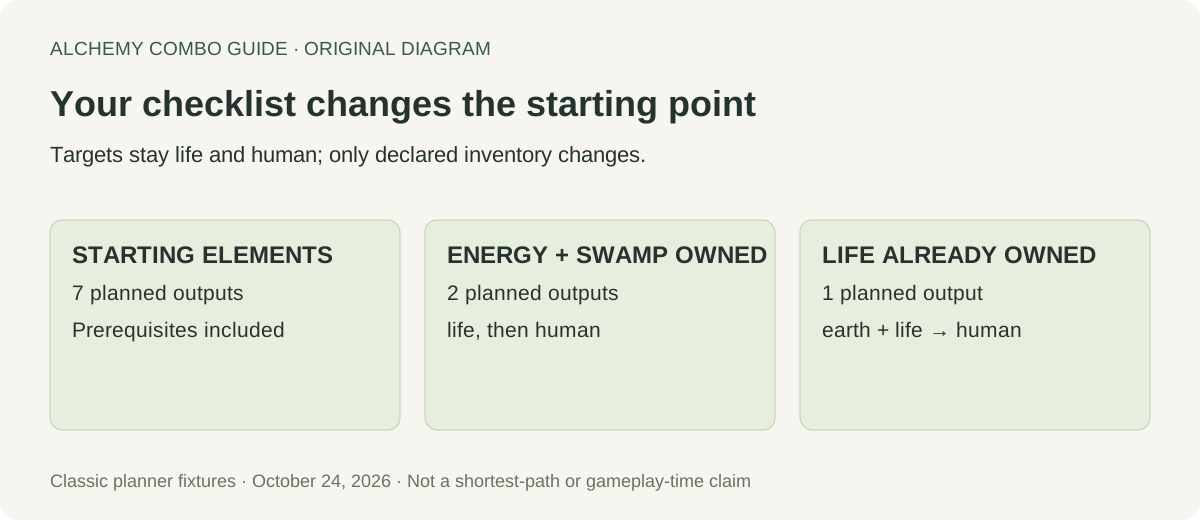
A readable Classic example
For life and human, the following is the route returned from the starting checklist. The recipe facts come from the official Classic dataset used by our Classic finder. The official hints also list energy with swamp for life and earth with life for human. This is a chosen route, not every possible recipe for either target.
- fire + air → energy
- water + earth → mud
- water + air → rain
- earth + rain → plant
- mud + plant → swamp
- energy + swamp → life
- earth + life → human
The earlier Classic data capture was checked on October 20, 2026; the life and human hint pages were reread on October 24, 2026. This page uses regular Classic elements only. Hidden gems, historical platform extras and Little Alchemy 2 recipes are outside this dataset. For the sequel, use the separate version-specific guide.
Use a plan as a checklist, not as a progress claim
Choose a target from the menu and add it to the target chips. Remove a chip to take that goal out. Enter owned elements with their exact names, separated by commas, then rebuild. An unknown name produces an explicit message instead of being guessed or silently ignored. There is no connection to your game save or the inventory in our other tools.
The “Add to my checklist” button is available only when that row’s ingredients are already in the checklist. Use it after confirming the output in your game. It updates this planner’s declaration and rebuilds the remaining order; it does not perform the combination for you. A later row stays disabled until its prerequisites have been declared. If you add an item by mistake, remove its name from the box and rebuild.
Download plan CSV exports the current output order with ingredient and output columns. It does not export every recipe, your game save or the attempt journal. The file is a snapshot: later edits in the browser do not change an earlier download. This page keeps choices in memory only. Reloading returns to the life-and-human example, so download a plan you want to keep before leaving.
What our dependency checks establish
Before publishing, we checked that every emitted pair belongs to the source data and that its ingredients are already available earlier in the plan or in the declared inventory. We also checked that a shared output is emitted once, an already-owned target needs no reconstruction, and unsupported names produce errors. These checks test the planner’s ordering and boundaries, not the correctness of every possible game action.
A second check used all supported names in small target batches. Each batch began with the starting checklist and every requested target was reached by a valid source-backed proof. The empty-inventory case returned no route for life and human instead of making up a starting point. A deliberately circular toy dataset also returned no route. Neither test proves shortest paths or checks a player’s actual save.
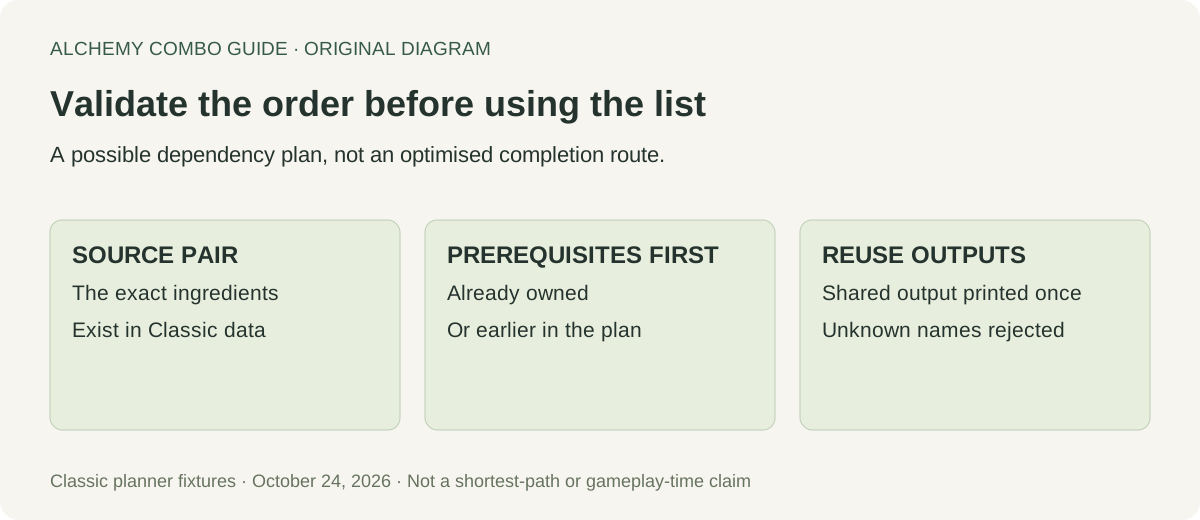
Questions about following cheats in order
Do I need to follow the same order for the whole game?
No fixed whole-game order is required by this tool. It constructs an order for your chosen targets and declared inventory. A different goal set or another usable recipe can give another valid list. Do not interpret the example’s numbered rows as a universal completion sequence.
Why did choosing human also put life in my plan?
The selected Classic proof for human uses life with earth. If life is not in your declared inventory, the planner must include its prerequisites first. When life is also a selected target, that same output satisfies both roles without printing a second life row.
Why does owning life remove so many earlier rows?
Your declaration supplies life directly. The planner no longer needs to explain how you obtained it. It does not assume that energy, swamp or other ancestors are also in your library. Add those separately only when you actually have them.
Is the shared plan the fewest possible combinations?
No. The route rule chooses a reachable proof from the available recipe data, then reuses shared outputs. It does not exhaustively optimise every alternative route. The counters compare the selected lists; they are not a speed claim, a play-time estimate or a completion percentage.
Sources and scope
Recipe names and pairs come from the official Classic public data linked by the game, captured for our existing Classic dataset. The official hints service separates Classic from the sequel. Our target joining, checks, diagrams and dated software comparisons were created for this planner. They are independent guide features, not an official game service.
The questions above are editorial questions about this tool, not quotations attributed to players. For a history of what you actually tried, use the separate combination journal; this page plans discoveries and does not record observed attempts.
See how the shared plan changes
Original diagrams and explanation with synthetic narration. The comparison is a software fixture, not a timed gameplay experiment.